Best Brushes for Cleaning Solar Panels: What Manufacturers Actually Recommend
Updated: Oct 8
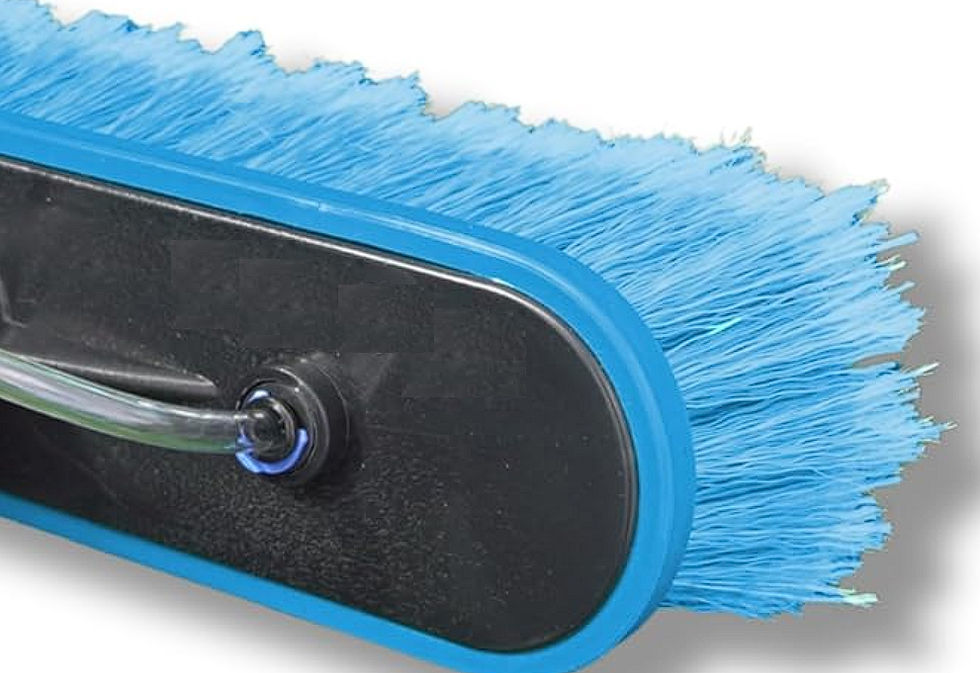
When most people think about solar panel cleaning, they naturally focus on the water. Should the water be filtered? Should it be deionized? Should detergents be used? Those are all reasonable questions. But there is another part of the cleaning process that deserves just as much attention: the brush.
A solar panel cleaning brush is in direct physical contact with the glass surface of the module. That means the type of brush used, how clean it is, how much pressure is applied, and whether dirt is adequately wetted can all matter. The goal should not simply be to scrub the panel until it looks clean. The goal is to remove dirt while minimizing unnecessary abrasion.
Solar Panels Are Tough — But Their Surfaces Should Still Be Treated Carefully
Modern solar panels are designed to survive decades outdoors in sun, rain, wind, dust, and changing temperatures. But that does not mean their glass surfaces should be cleaned aggressively.
Many solar modules use specially treated glass or anti-reflective coatings designed to reduce reflected sunlight and allow more light to reach the solar cells. Because of this, solar manufacturers routinely caution against abrasive cleaning methods. For example, Qcells warns that dust and dirt themselves can act as abrasive materials and that improper cleaning can potentially cause scratches or damage to the glass surface and anti-reflective coating.
The lesson is simple: Solar panels should be cleaned gently.
The Real Enemy Is Abrasion
Imagine rubbing fine sand across a piece of glass. Even if the cloth or brush you're holding is extremely soft, the sand trapped between the cleaning tool and the glass can become the abrasive. The same principle applies to solar panels.
Dust, road grime, pollen, dried mud, and other particles can accumulate on the module surface. That means good solar panel cleaning is not simply about choosing the best brush. It is about managing the entire cleaning process so that abrasive particles are loosened and removed rather than repeatedly dragged across the glass.
Water plays an important role in this process. Adequately wetting the panel helps loosen contamination and allows dirt and abrasive particles to move away from the surface as the panel is cleaned. Water helps soften and carry away dirt so less pressure is required from the brush.
More Scrubbing Isn't Necessarily Better Cleaning
One of the easiest mistakes to make when cleaning solar panels is assuming that more pressure means better cleaning. It doesn't. If contamination is difficult to remove, pushing harder on the brush is not necessarily the best solution. Good technique means allowing water, repeated gentle passes, and appropriate cleaning tools to do the work. Our approach is simple: thoroughly soak, don't rush, and use the least amount of force necessary to get the panel clean.
What About Rotating Brushes?
Rotating-brush systems can make solar cleaning easier and faster. But that doesn't mean gentler. In fact, some solar manufacturers place restrictions on certain types of automated or rotating brush systems. Due to this concern, Interstellar does not use mechanically rotating brush heads, helping minimize unnecessary abrasion and stress on the panel surface.
Do Solar Panels Need Detergent?
No. Plain water can remove a surprising amount of ordinary dust and environmental contamination. Some solar manufacturers permit certain approved cleaning agents for stubborn contamination, while others recommend avoiding chemicals entirely or impose restrictions on what can be used.
Interstellar does not use any chemicals, period. That also reduces concerns about chemical compatibility with modules, roofing materials, landscaping, drainage areas, pets, and the surrounding environment.
What About Pressure Washing?
High-pressure washing is another area where manufacturer instructions vary. Some solar manufacturers prohibit high-pressure cleaning methods, while others specify maximum allowable water pressures. High-pressure cleaning can also introduce unnecessary risks around electrical components and other sensitive areas of a PV installation.
At Interstellar, we prefer a gentler approach: Adequate water flow, soft brushes, gentle pressure, and careful technique.
How We Approach Solar Panel Cleaning
At Interstellar Solar Cleaners, our goal is not simply to make solar panels look clean. We want to clean them in a way that respects the fact that solar modules are long-term investments expected to operate outdoors for decades.
That means we focus on minimizing unnecessary abrasion. We use soft, non-abrasive cleaning equipment, efficient use of water, reasonable pressure, and careful cleaning techniques designed to loosen and remove contamination rather than aggressively grind it across the glass. It may take a little more patience than simply attacking the panels with stiff brushes, strong chemicals, or high-pressure equipment. But solar panels aren't concrete sidewalks. They are precision energy-producing equipment. And we believe they should be treated that way.
Sources
LONGi Solar — PV Module Maintenance Manual. LONGi recommends soft foam, nonwoven fabric, soft sponges, soft brushes, and certain fine nylon-bristle brushes. It also warns against abrasive cleaning materials.
Canadian Solar — Installation Manual / Module Cleaning Guidelines. Canadian Solar recommends water and non-abrasive cleaning implements and warns that rubbing or scraping dry dirt may cause micro-scratches.
Qcells — Installation and Operation Manual. Qcells warns that dust and dirt are abrasive and that improper cleaning can damage the glass surface or anti-reflective coating.
JinkoSolar — Module Installation Manual. JinkoSolar recommends soft cleaning materials and warns against abrasive materials when cleaning modules.
Always consult the cleaning and maintenance instructions provided by the manufacturer of your specific solar modules.


Comments