Can You Walk or Sit on Solar Panels? What Solar Panel Manufacturers Actually Say
Updated: Aug 28

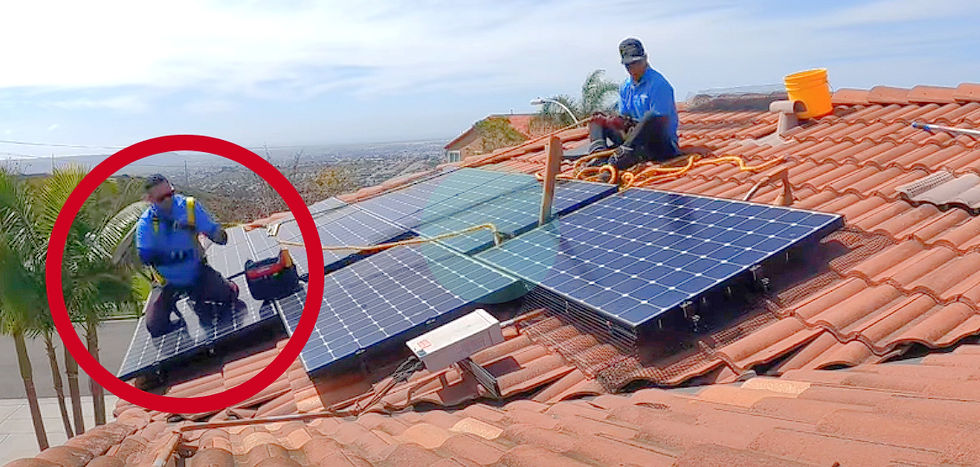
If you've ever watched solar panels being installed or cleaned, you may have seen someone standing, kneeling, sitting, or even walking directly on the panels. That naturally raises a question: Is it actually safe to walk or sit on solar panels? You may find conflicting answers online. Some installers and cleaners claim that modern solar panels are strong enough to support a person's weight. Others say stepping on a panel can crack the solar cells even when the glass remains completely intact. So who is right?
The best place to look for an answer isn't an online forum or someone's personal experience. It's the companies that actually manufacture the solar panels. And their guidance is remarkably consistent: Do not walk, stand, or sit on solar panels.
What Solar Panel Manufacturers Say
Canadian Solar gives an especially clear warning in its installation manual:
“Do not stand, step, walk, and/or jump on modules under any circumstances.”
Canadian Solar explains why: localized heavy loads can cause severe microcracks at the solar-cell level, potentially compromising module reliability and even affecting warranty coverage.
Trina Solar and LONGI give similar instructions. When multiple major manufacturers independently give essentially the same instruction, there is a good reason to take it seriously.
But Aren't Solar Panels Designed to Be Strong?
Yes. Solar modules must withstand substantial environmental forces during their service life, including wind, snow, hail, temperature changes, and other stresses. But there is an important distinction:
Distributed load is not the same as concentrated load.
Snow, for example, tends to distribute its weight across a relatively large portion of a module.
A person's foot, knee, hand, or body weight can concentrate a substantial force into a much smaller area. That concentrated loading can cause localized bending, placing mechanical stress on the thin and brittle silicon solar cells beneath the glass.
“But I've Walked on Panels Before and Nothing Happened”
That doesn't necessarily prove the panel was unharmed. One of the most misunderstood aspects of solar-panel damage is that the front glass does not have to visibly crack for damage to occur underneath it. Solar cells are made from thin crystalline-silicon wafers. These cells can develop tiny fractures known as microcracks. Some microcracks may be invisible during an ordinary visual inspection.
The key lesson is this: a panel can look perfectly normal from the roof while potentially having cell-level damage beneath the surface.
Is Standing on the Aluminum Frame Safe?
Sometimes you may see workers attempting to place their feet near or directly over the aluminum frame rather than in the center of the glass. From a structural standpoint, loading near a supported edge may create less bending stress in the middle of the module than stepping directly in its center. But unless the specific module and mounting-system manufacturer provides instructions allowing workers to use the frame in that manner, the safest approach remains simple: Keep body weight off the solar modules.
Why Do Some Solar Cleaners Still Walk on Panels?
Sometimes it's simply the easiest way to reach a difficult section of an array. Large or tightly packed residential systems can leave very little roof space between rows of modules. Walking across the array may therefore seem faster and easier than using appropriate extension equipment or approaching the panels from another location. But convenience doesn't change the manufacturer's instructions.
At Interstellar Solar Cleaners, we believe a homeowner shouldn't have to accept unnecessary risk to an expensive solar investment simply because walking across the panels makes a cleaning job easier.
The Bottom Line
Can a solar panel physically support someone's weight without the glass immediately breaking?
Sometimes, yes.
Does that mean walking or sitting on solar panels is a good idea?
No. Major solar manufacturers including Canadian Solar, Trina Solar, and LONGi specifically instruct people not to stand or walk on their modules. Not every footstep will necessarily damage a solar panel. But damage does not have to be visible, and there is no good reason to expose an expensive solar system to a preventable risk.
At Interstellar, when we clean solar panels, our goal isn't simply to make them look clean. It's to clean them without unnecessarily placing the system at risk. That means we do not use solar panels as walking, standing, kneeling, or sitting surfaces simply because doing so would make the job more convenient. Instead, we use appropriate reach and cleaning techniques designed to access panels while keeping body weight off the modules.
Sources
Canadian Solar — Installation Manual of Standard Solar Modules
Trina Solar — PV Module Installation Manual
LONGi Solar — PV Module Installation Manual
International Energy Agency Photovoltaic Power Systems Programme (IEA PVPS) — research concerning photovoltaic-module failures, mechanical loading, cracking and failure detection


Comments